





How Elysium could accrue $100M+ a year to Hyperliquid
Elysium is designed to make L2 growth accretive to Hyperliquid through AQAv2 USDC revenue, HyperCore arbitrage volume, and builder incentives.
Most Layer 2s are designed to make their Layer 1 more scalable.
That does not necessarily mean they make it more valuable.
Elysium is built around a different premise: if the L2 grows, the underlying Hyperliquid economy should grow with it.
The most important part is that this value does not come from conventional L2 settlement fees. Those are likely to be small by design.
Instead, Elysium introduces two much larger potential value-accrual channels: native USDC expanding Hyperliquid's AQAv2 revenue base and Elysium trading activity generating additional volume on HyperCore.
Under one illustrative scenario, the first mechanism alone could exceed $100M in incremental annual revenue for Hyperliquid.
That is what we mean by a value-accretive L2.
Key takeaways
- Traditional rollups pay their L1 for settlement and data availability, but those costs have become extremely small relative to the economic activity L2s process.
- Elysium will settle to HyperEVM, but direct settlement fees are not the core value-accrual thesis.
- Under AQAv2, approximately 90% of cost-adjusted reserve yield generated by USDC on Hyperliquid accrues to the protocol.
- If Elysium attracted roughly as much native USDC as Base holds today, a conservative 3% reserve-yield assumption implies more than $110M in incremental annual revenue.
- Elysium's planned HyperCore read/write infrastructure creates another feedback loop: more Elysium liquidity can create more arbitrage against HyperCore, generating additional HyperCore volume and fees.
- Elysium also reserves 25% of sequencer revenue for builders, giving applications a direct economic incentive to generate blockspace demand.
The problem with traditional L2 economics
Rollups execute transactions away from Ethereum and periodically anchor their state back to L1.
Ethereum typically provides two critical services:
- Settlement: rollups post state commitments to Ethereum, with optimistic rollups using challenge mechanisms and ZK rollups using validity proofs.
- Data availability: transaction data needed to reconstruct or verify the rollup state is made available, increasingly through blobs.
This is how rollups can inherit security properties from Ethereum while operating with much higher throughput and lower user fees.
But Ethereum has intentionally made this infrastructure cheaper.
EIP-4844 introduced temporary blob storage specifically to reduce the cost of publishing rollup data. Subsequent scaling work has continued in the same direction: more data capacity at lower cost.
The result is good for users, but it creates an interesting economic problem for the L1.
L2 activity can grow much faster than the amount those L2s directly pay Ethereum.
For example, L2BEAT reports that Base processed roughly 11M operations per day around mid-September while averaging only about $1.5K per day in Ethereum operating costs over the previous year. OP Mainnet averaged roughly $135 per day over a similar period.
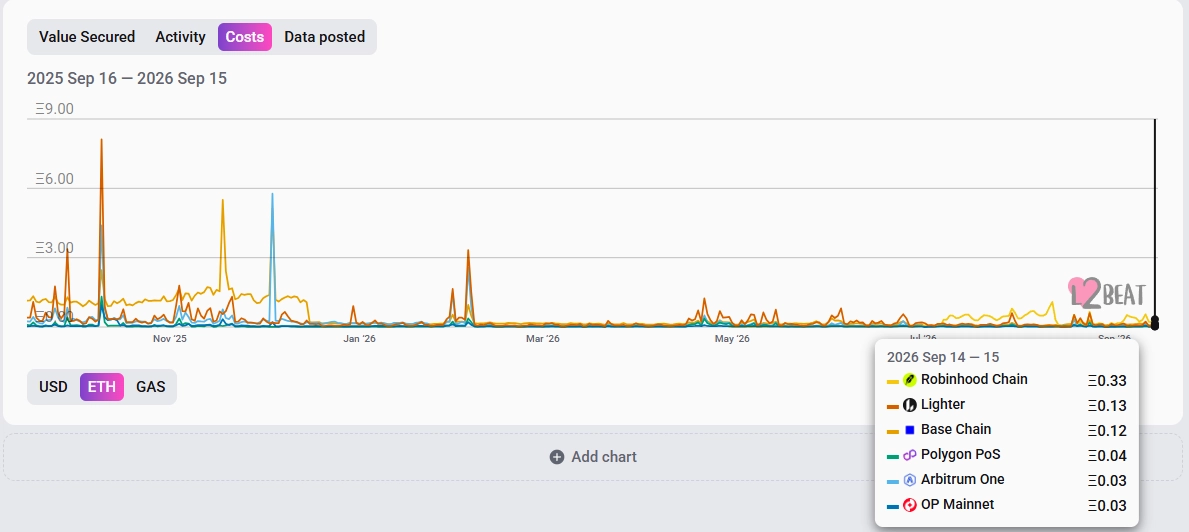
Source:
That does not mean L2s provide no value to Ethereum. They expand its ecosystem, use ETH, and increase the amount of economic activity ultimately anchored to Ethereum.
But the direct monetary capture from L2 execution is weak relative to the activity happening above it.
That is the problem Elysium is designed differently around.
Elysium does not rely on settlement fees
Elysium is an Arbitrum Orbit chain built with Nitro and ArbOS that settles to HyperEVM.
Its data availability model uses AnyTrust. Instead of publishing every byte of transaction data to HyperEVM under normal operation, a Data Availability Committee stores the full data while a compact certificate is posted onchain. Full data can fall back to HyperEVM if the committee becomes unavailable.
The result is intentionally cheap parent-chain settlement.
So Elysium is not going to generate $100M for Hyperliquid by paying enormous settlement fees.
That would defeat the purpose of scaling.
The value comes from what Elysium can cause to happen elsewhere in the Hyperliquid economy.
Native USDC creates a new revenue channel
AQAv2 fundamentally changes the economics of stablecoin liquidity on Hyperliquid.
Under AQAv2, Coinbase acts as the treasury deployer for USDC and Circle as the technical deployer. Approximately 90% of the cost-adjusted reserve yield generated by USDC on Hyperliquid is shared with the protocol, with revenue ultimately sent to the Assistance Fund. Yield accrual began in August 2026, with the first settlement scheduled for October.
That makes stablecoin supply itself economically valuable to Hyperliquid.
Elysium makes this particularly interesting because USDC used on the L2 can remain backed by native USDC on HyperEVM through its canonical bridge architecture.
When a HyperEVM ERC-20 is moved onto Elysium, the underlying asset is locked on HyperEVM and a 1:1 representation is created on Elysium.
So if Elysium attracts new USDC from outside the existing Hyperliquid ecosystem, that capital can increase the USDC base on which AQAv2 generates revenue.
This is where the numbers become interesting.
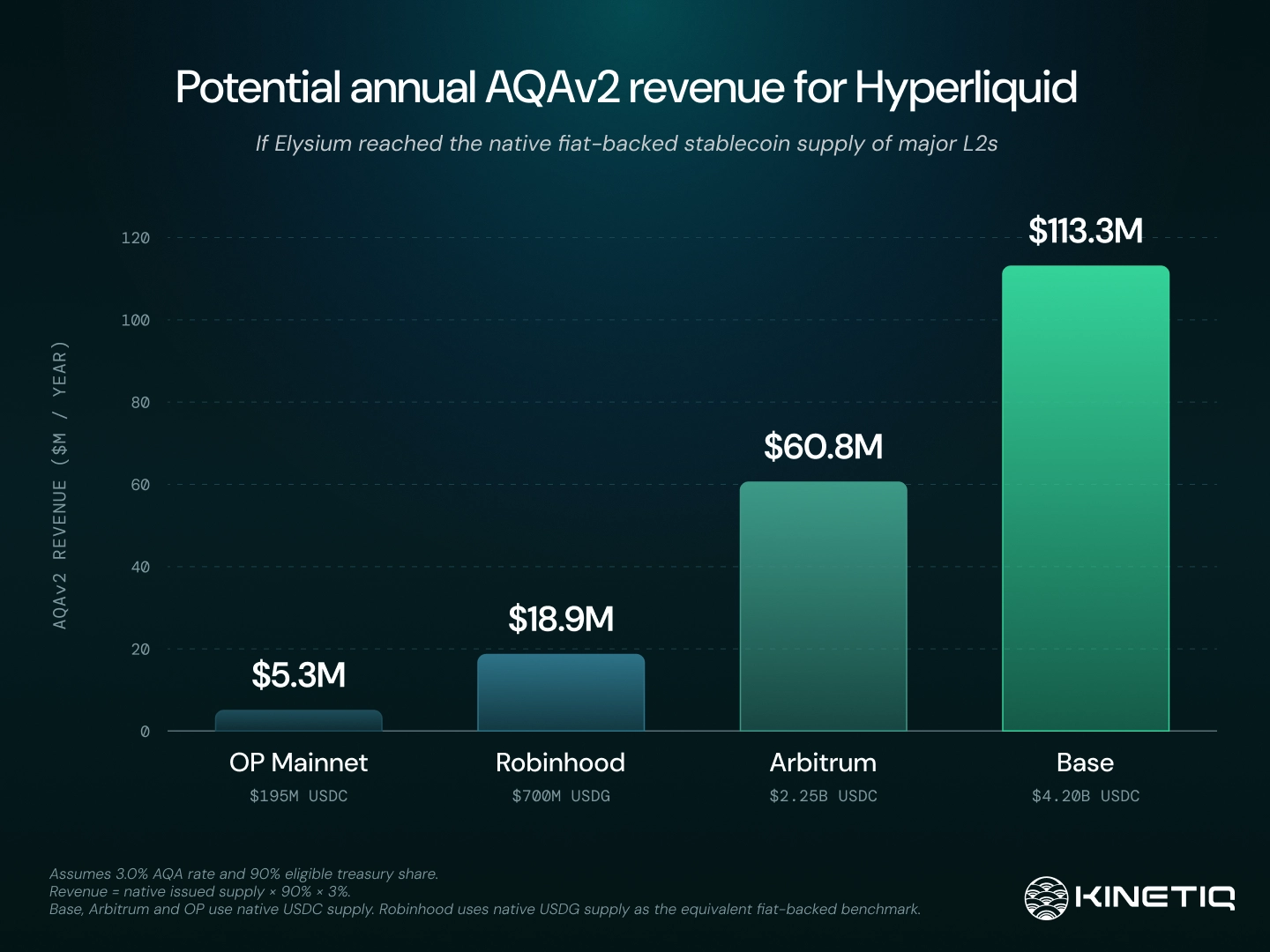
Base currently holds roughly $4.3B of USDC.
Using an illustrative 3% cost-adjusted reserve yield:
$4.3B × 3% × 90% = ~$116M per year
In other words, if Elysium eventually attracted a Base-sized amount of incremental native USDC, it could theoretically contribute more than $110M in annual AQAv2 revenue to Hyperliquid from stablecoin supply alone.
Source: https://defillama.com/
USDC supply can move, interest rates can fall, the cost-adjusted AQA rate can change, and Elysium would need to attract genuinely incremental liquidity rather than simply moving existing Hyperliquid USDC between environments.
But the mechanism is already real.
AQAv2 turns every incremental dollar of native USDC into a potential recurring revenue-producing asset for Hyperliquid.
Elysium liquidity can create HyperCore volume
The second mechanism is more structural.
Elysium is being built as a high-performance EVM optimized for trading applications, including AMMs, PropAMMs, automated strategies, and other latency-sensitive financial infrastructure.
The important part is its proximity to HyperCore.
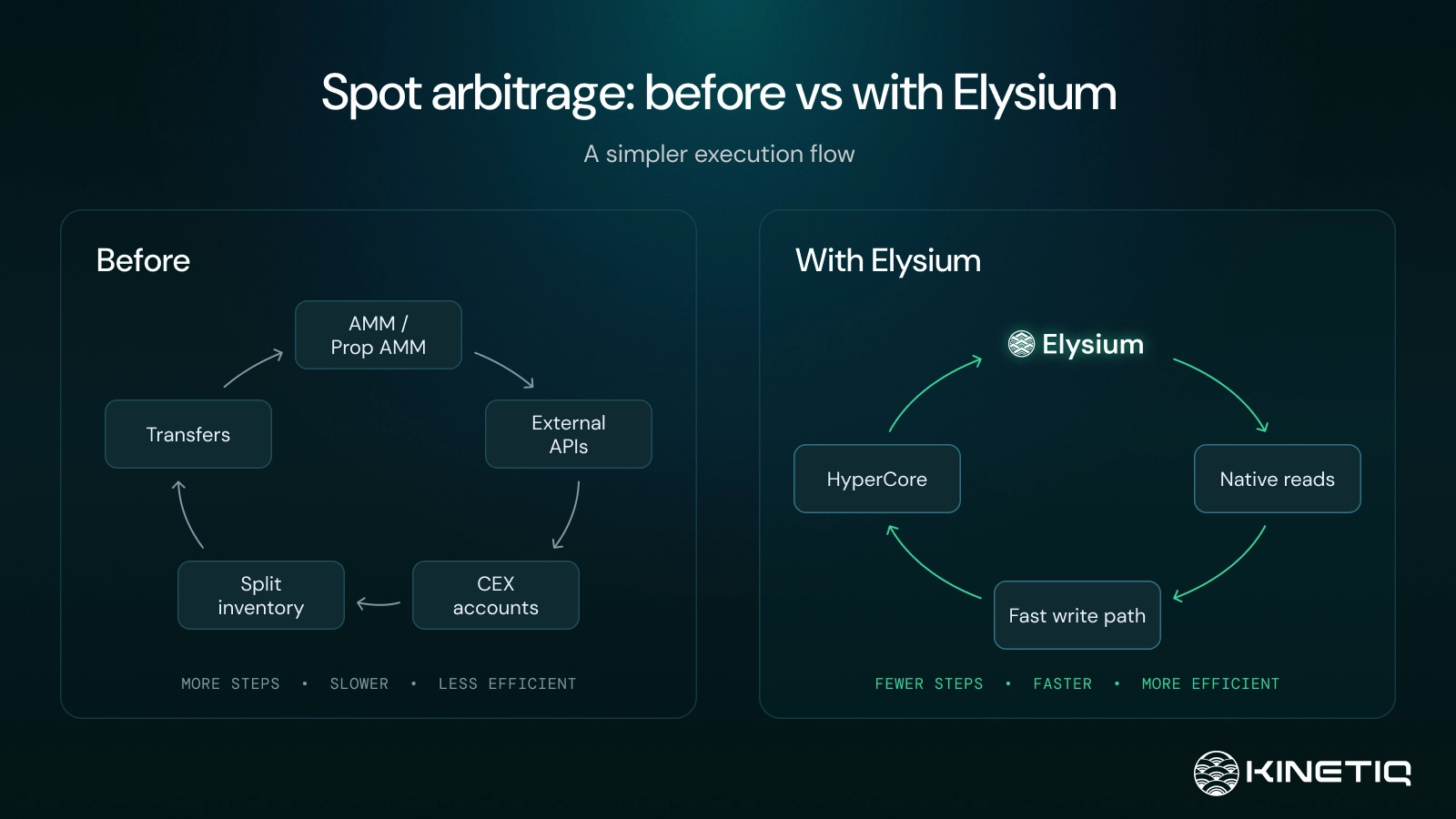
Today, an arbitrage fund trading between an onchain AMM and a centralized exchange typically needs infrastructure on both sides.
Capital sits across multiple venues. Market data arrives through separate APIs. Execution systems need to coordinate transactions across completely different environments. Moving inventory between them introduces latency, so sophisticated firms generally pre-fund every venue they trade.
Elysium can compress much of that architecture into one ecosystem.
Contracts will be able to read data including:
- Full HyperCore order-book depth
- Best bid and offer
- Mark, oracle, and spot prices
- Balances and positions
- Depth within defined basis-point ranges
- Expected slippage and other computed market information
The planned read path targets roughly 150 to 350 ms in-EVM freshness. The write path is designed to allow Elysium applications to submit trading intents to a trade-only agent operating on the user's own HyperCore account, targeting roughly 100 to 200 ms from intent to resting order.
That creates a very different arbitrage environment.
Elysium provides programmable execution. HyperCore provides the deep order book.
Source: Own work
Imagine an asset trading at $10.00 on a PropAMM on Elysium and $10.05 on HyperCore.
An arbitrageur can buy the cheaper leg and sell the expensive one. That trade closes the spread while generating volume on both venues.
Now repeat that process continuously across hundreds of assets and multiple market makers.
The more liquidity Elysium attracts, the more opportunities there are for differences between Elysium pricing and HyperCore's order books to be arbitraged away.
And that matters because HyperCore trading generates fees.
Hyperliquid directs trading fees across its community fee system, including the Assistance Fund. Fees reaching the Assistance Fund are programmatically converted into HYPE, and HYPE held there is treated as burned. Spot deployers can retain a portion of the fees generated by their markets, so the exact amount flowing to the Assistance Fund varies by market.
The mechanism is therefore:
More Elysium liquidity → more arbitrage opportunities → more HyperCore volume → more Hyperliquid fees → potentially more HYPE burned
This is not a contractual payment from Elysium to Hyperliquid.
It is arguably more interesting than that.
It makes Elysium's own liquidity a potential driver of activity on the L1.
The key difference
Traditional L2 value capture is mostly based on what the L2 pays its parent.
Elysium's thesis is based on what the L2 causes its parent to earn.
Settlement remains cheap.
But if Elysium attracts $1B of net-new USDC, that liquidity potentially expands Hyperliquid's AQAv2 revenue base.
If an Elysium PropAMM generates billions of dollars of volume, arbitrage against HyperCore can turn part of that activity into Hyperliquid spot volume.
If an application attracts new traders and assets to Elysium, those assets can eventually graduate into HyperCore spot markets and HIP-3 perpetual markets.
Elysium does not need expensive settlement to be economically relevant to Hyperliquid.
It needs successful applications.
The builder flywheel
That is also why 25% of Elysium sequencer revenue is reserved for builders.
Applications consuming Elysium blockspace can receive a share of the economic activity they create and use it for rebates, incentives, liquidity programs, or entirely new mechanisms.
This is a growth mechanism designed to make the other two value-accrual loops larger.
More successful applications generate more Elysium activity. More activity can attract more stablecoin liquidity and deeper markets. Deeper markets create more opportunities for interaction with HyperCore.
The builder share is therefore less about extracting revenue and more about increasing the surface area from which revenue can eventually emerge.
What could challenge the thesis
There are several important caveats.
USDC needs to be incremental. If users simply move existing Hyperliquid USDC onto Elysium, the AQAv2 revenue base does not meaningfully expand. The strongest version of the thesis requires Elysium to attract capital from outside Hyperliquid.
Interest rates matter. AQAv2 revenue is tied to reserve yield. A significant decline in short-term rates would reduce the revenue generated by the same USDC supply.
Liquidity needs to be real. Arbitrage only becomes economically meaningful if Elysium develops deep, active markets that interact continuously with HyperCore.
The HyperCore read/write edge is phase two. The full arbitrage architecture described above is planned for approximately four weeks after mainnet and remains pre-launch infrastructure until deployed and tested in production.
Not every HyperCore fee reaches the Assistance Fund. Market structure, maker rebates, and deployer fee shares affect how much trading revenue ultimately becomes HYPE buyback and burn demand.
The $100M+ scenario is therefore a demonstration of the mechanism's potential scale, not a prediction that Elysium will generate that amount.
The bottom line
Elysium's value-accrual thesis does not depend on making Hyperliquid expensive to use.
It depends on making the Hyperliquid economy larger.
More external USDC can mean more AQAv2 revenue.
More Elysium liquidity can mean more arbitrage and HyperCore volume.
More HyperCore activity can mean more fees and more HYPE flowing into the Assistance Fund.
And the 25% builder share is designed to push that flywheel further by giving applications a direct economic incentive to create blockspace demand.
That is the fundamental difference.
Elysium is not designed to extract value from Hyperliquid in order to scale. It is designed so that scaling Elysium can create value for Hyperliquid.
That is the idea behind a value-accretive L2.
Builders can review the Elysium technical overview and follow @Enter_Elysium for launch updates.